
OSHA Guardrail Requirements: What the Rules Actually Say, and What They Don’t Cover
Ask five people what OSHA requires for guard railing and most of them will say the same thing: 42 inches.
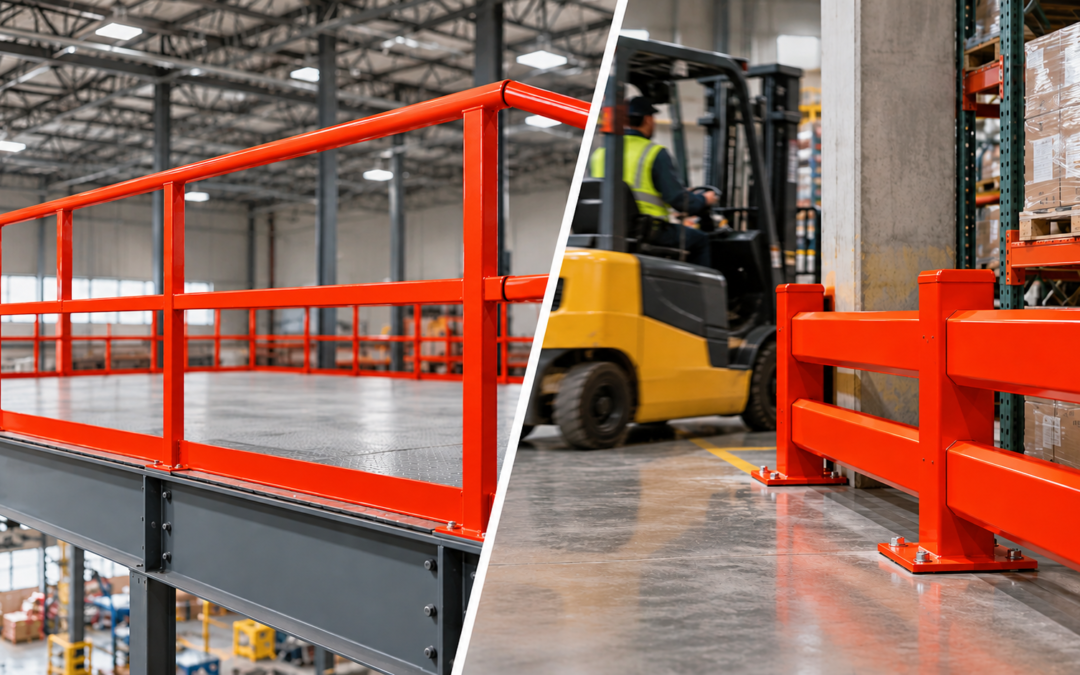
That number is real, but it belongs to one kind of guard rail: the kind that keeps a person from falling off an edge. The yellow steel rail that keeps a forklift out of a walkway is a different product built for a different job, and OSHA handles it in a completely different way.
When facilities mix the two up, they end up with a mezzanine rail that wouldn’t survive an inspection, or a pedestrian aisle protected by something that folds the first time a lift truck touches it.
Here’s how each one works, what the numbers are, and how to tell which one each part of your building needs.
The 30-Second Version
OSHA’s guardrail specifications (29 CFR 1910.29) are fall protection rules. They apply to any open edge 4 feet or more above a lower level. The top rail has to sit at 42 inches, plus or minus 3, and hold 200 pounds. A rail built to that spec is not built to stop a forklift.
Floor-level impact protection (rail along walkways, around racking, in front of machinery) has no OSHA dimension table. But OSHA still expects you to control the hazard of trucks and people sharing the same space, and it will cite you if you don’t.
Two Kinds of Guard Rail
| Fall protection guardrail | Impact (traffic) guard rail | |
| What it stops | People falling off an edge | Forklifts, carts, and loads hitting people, racking, and equipment |
| Where it goes | Mezzanines, platforms, catwalks, open-sided floors, stairs | Pedestrian walkways, rack ends, machinery, columns, doorways, utilities |
| What governs it | OSHA 29 CFR 1910.28 and 1910.29 | OSHA 1910.176 and 1910.178 in general terms, the General Duty Clause, and industry standards |
| Key spec | 42″ ±3″ top rail, 200 lb load | Impact resistance, anchored to the slab |
| Typical build | Top rail, midrail, toeboard | Heavy steel rail on anchored posts, bollards, rack guards |
When Does OSHA Require a Guardrail?
Under 29 CFR 1910.28(b)(1), general industry employers have to protect workers from falling off any unprotected side or edge that is 4 feet or more above a lower level. Guardrail is one of three accepted options, alongside safety nets and personal fall arrest. For a permanent edge inside a facility, guardrail is almost always the practical choice because it protects everyone who walks past without anyone having to clip in.
In a warehouse or plant, that 4-foot rule usually shows up in these places:
- Mezzanine edges, including storage mezzanines and the edges of pallet drop areas
- Elevated work platforms, catwalks, and crossover walkways
- Open-sided floors and platforms around equipment
- Holes and openings in floors
- Any flight with at least 3 treads and 4 risers needs handrails and a stair rail system on open sides (1910.28(b)(11)).
The loading dock exception. Dock edges are over 4 feet, but OSHA recognizes that you can’t rail the working side of a dock while trucks are being loaded. 1910.28(b)(1)(iii) allows work there without fall protection when the employer can show it isn’t feasible, the work is in progress, access is limited to authorized employees, and those employees are trained under 1910.30. The exception covers the work, not an idle dock. An open position with no trailer is still an open edge, which is why dock barriers and removable rails exist.
The OSHA Guardrail Specifications
When a guardrail is required, 1910.29(b) sets the construction rules. The ones that matter most:
- Top rail height: 42 inches, plus or minus 3 inches (39 to 45 inches), measured from the walking-working surface. It can be higher than 45 inches if the system meets every other requirement.
- Midrails: Required when there’s no wall or parapet at least 21 inches high. The midrail goes halfway between the top rail and the walking surface. Screens, mesh, or intermediate members are acceptable alternatives, as long as no opening is wider than 19 inches.
- Top rail strength: Must withstand at least 200 pounds applied within 2 inches of the top edge, outward or downward. Under that load, the top rail can’t deflect below 39 inches.
- Midrail strength: Midrails, screens, and mesh must withstand at least 150 pounds outward or downward.
- Surfaces: Smooth enough to prevent punctures, cuts, and snagged clothing. Rails can’t overhang the end posts in a way that creates a projection hazard.
- Rail size: Top rails and midrails have to be at least a quarter inch thick or in diameter.
- Stairs: Handrails sit 30 to 38 inches above the stair nosing. Stair rail systems installed on or after January 17, 2017 must be at least 42 inches high.
Toeboards. Where tools, parts, or stored material could fall from an elevated edge onto people below, 1910.28(c) requires falling-object protection, and a toeboard is the usual answer. Under 1910.29(k), a toeboard has to be at least 3.5 inches high, withstand 50 pounds, and leave no more than a quarter-inch gap at the floor. Storage mezzanines are where this most often gets missed.
Pallet drop areas. A mezzanine edge where product is loaded by forklift is the hardest edge in the building to protect, because it has to open. Chains and rope are common, and so is leaving the gap open between loads. A pallet safety gate solves this by design: the side facing the forklift opens while the side facing the mezzanine closes, so the edge is never fully open.
What OSHA Doesn’t Specify: Impact Protection on the Floor
There’s no OSHA table that tells you how tall a forklift barrier has to be or how much force it has to stop. That surprises a lot of people. What OSHA does require is more general, but it still applies:
- Safe clearances and marked aisles (1910.176(a)). Where mechanical handling equipment is used, there has to be enough clearance for aisles, loading docks, doorways, and turns. Permanent aisles and passageways have to be marked.
- Powered industrial truck rules (1910.178). These cover how forklifts are operated and how operators are trained, including how trucks behave around pedestrians.
- The General Duty Clause (Section 5(a)(1) of the OSH Act). Employers have to protect workers from recognized hazards that are likely to cause death or serious injury. Forklift and pedestrian collisions are about as well recognized as workplace hazards get.
Painted lines satisfy the “marked” part of 1910.176. They don’t stop a truck. If people and forklifts share a known conflict point with nothing between them but paint, the General Duty Clause exists for exactly that situation.
For design and testing, the industry looks to standards such as ANSI MH31.2 for industrial steel guardrail, along with the manufacturer’s rated impact performance for each product.
Why a fall rail isn’t a forklift rail. A compliant mezzanine rail is tested to 200 pounds. A loaded forklift weighs several tons, and even at walking speed it carries many times that force into whatever it hits. Handrail-grade pipe will bend, and the anchors will pull out of the floor. Impact rail uses heavier steel, bigger base plates, and anchorage sized for the load, because the anchors and the slab are what actually absorb the hit.
Where Each Type Belongs in Your Building
Walk your floor with two questions: where could someone fall 4 feet or more, and where do trucks and people share space? Most facilities end up with a mix like this.
- Mezzanine edges: Fall protection guardrail with a midrail, plus toeboards wherever product is stored near the edge.
- Mezzanine pallet drops: A pallet safety gate, not a chain.
- Stairs and platforms: Stair rails and handrails at the required heights.
- Pedestrian walkways beside forklift aisles: Impact rail, usually double-rail so both the truck and the load make contact with steel. Put openings at planned crossing points and offset them so people have to stop and look before they step out.
- Rack ends and aisle entrances: Rack end guards or guard rail across the end of the run, plus column protectors on the uprights that take the most hits.
- Building columns, doorways, and corners:
- Machinery, electrical panels, sprinkler risers, battery charging, and compressors: Guard rail or bollards on every side that faces traffic.
- Offices and break areas on the production floor: Guard rail around the perimeter, especially on corners that face an aisle.
- Dock areas: Barriers or removable rail on positions that aren’t in use, and impact protection for anything staged near the dock approach.
Common Mistakes We See
- Handrail-grade rail in a forklift aisle. It looks like protection and works as decoration.
- Paint as the only separation. Lines tell people where to walk. They don’t stop a truck that’s backing up with a blind spot.
- Anchors the slab can’t hold. Impact rail is only as strong as its anchorage. Thin or cracked slabs need a different base or a different product.
- Bent rail left in place. A damaged section has already done its job once. It won’t do it at full strength again. Replace it.
- Open or chained pallet drops. This is the most common fall exposure on storage mezzanines.
- No planned openings. If the rail blocks the path people actually take, they climb over it or unbolt a section. Design the openings in.
- Missing toeboards on storage mezzanines. Cartons get pushed to the edge, and eventually one goes over.
A Quick Guardrail Self-Check
Ten minutes and a tape measure will tell you most of what you need to know.
- Any edge 4 feet or more above a lower level without a guardrail?
- Top rails measuring between 39 and 45 inches?
- Midrails or mesh in place, with no opening wider than 19 inches?
- Toeboards anywhere material is stored near an elevated edge?
- Handrails and stair rails on every flight with 4 or more risers?
- Pallet drop areas closed when not in use?
- Any place where pedestrians and forklifts are separated only by paint?
- Impact damage on rack ends, columns, or equipment near traffic?
- Existing rail that’s bent, has loose anchors, or is missing sections?
The first item and the last three need a “no”; the rest need a “yes.” A miss on the first six is a fall protection question. A miss on the last three is an impact protection question.
Frequently Asked Questions
What is the OSHA guardrail height requirement?
The top rail must be 42 inches above the walking-working surface, plus or minus 3 inches, so between 39 and 45 inches (29 CFR 1910.29(b)(1)).
How much weight does an OSHA guardrail have to hold?
The top rail must withstand 200 pounds applied outward or downward within 2 inches of its top edge. Midrails and screens must withstand 150 pounds.
Does OSHA require guardrails on loading docks?
Dock edges are over 4 feet, so fall protection generally applies. OSHA allows an exception for the working side of a dock while loading is in progress, provided access is limited to trained, authorized employees.
Does OSHA require forklift barriers or bollards?
OSHA doesn’t specify dimensions for impact barriers. It does require safe clearances and marked aisles where forklifts operate, and the General Duty Clause requires employers to address recognized hazards such as forklift and pedestrian collisions.
The Bottom Line
OSHA tells you exactly how to build a rail that keeps people from falling. It leaves it to you to keep forklifts and people apart, and it holds you accountable for both.
You can see both problems from the floor. Measure the rails you have, look for the edges you missed, and notice where people and trucks share the same few feet of concrete.
U.S. Materials Handling supplies and installs guard railing, bollards, rack protection, mezzanine rail, and pallet safety gates across Central and Upstate New York from East Syracuse and Utica. If you’d like a second set of eyes, we’ll walk your facility with you, point out where fall and impact protection is needed, and check the condition of the rail you already have.
Call (315) 732-4111, or request a guard railing quote below.